Research Highlights

Research Highlights

Libration point orbits: a brief journey through fundamental dynamics and applications by Josep Masdemont

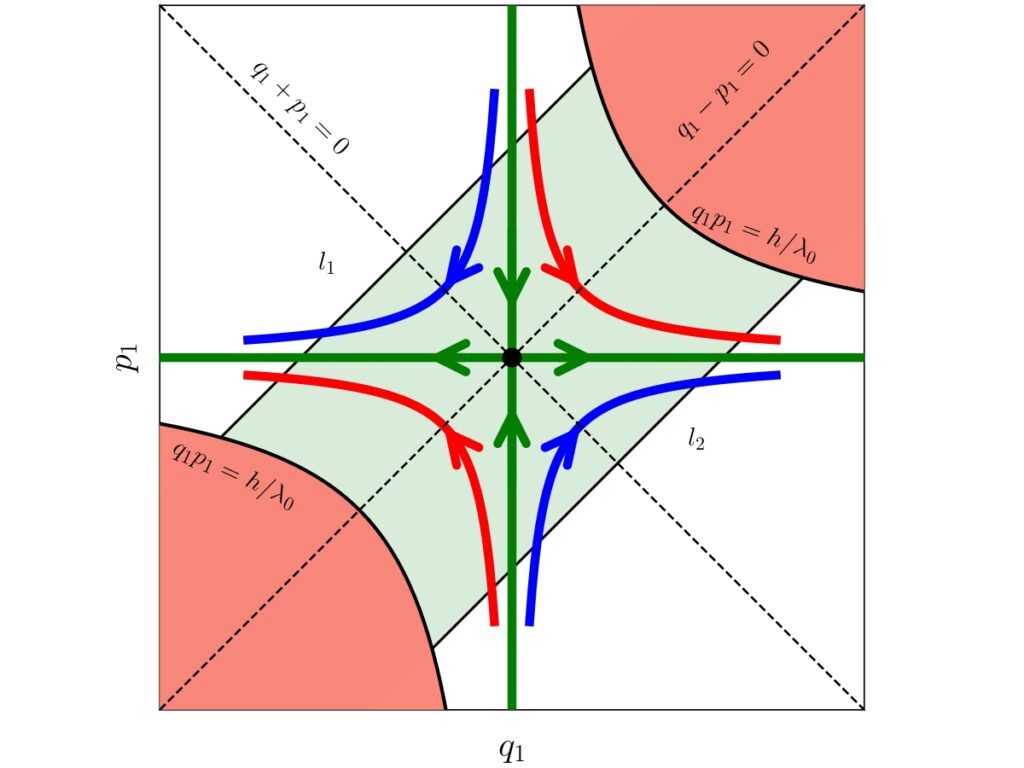
Josep Masdemont (DMAT, IMTech) The collinear equilibrium points of the Restricted Three-Body Problem (RTBP) were first described by the Swiss mathematician Leonhard Euler in the 18th century. The foundational understanding of libration point orbits has its roots in the pioneering work on the continuation of periodic orbits by Hénon and others laid the groundwork for […]
Research Highlights

Geometry and physics with geometric algebra, Geometric Mechanics, Vol. 2, No. 3 (2025), 337–383. by Sebastià Xambó

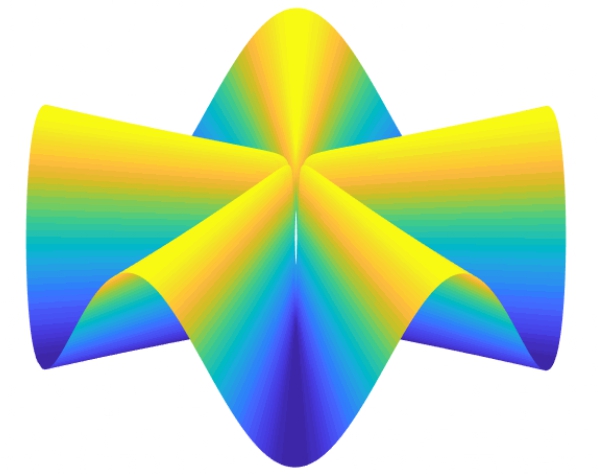
Geometric Mechanics, Vol. 2, No. 3 (2025), 337–383. Sebastià Xambó (DMAT) This work is dedicated to the memory of Miguel Carlos Muñoz Lecanda (MCML) (1946-2023), who was a Full Professor at UPC. Broadly speaking, his scientific interests were focused on the interactions between mathematics (mainly differential geometry) and physics (geometric mechanics, classical field theory), but

Research Highlights

Collective migration across scales: From PDEs to physical swarms by Gissell Estrada-Rodríguez

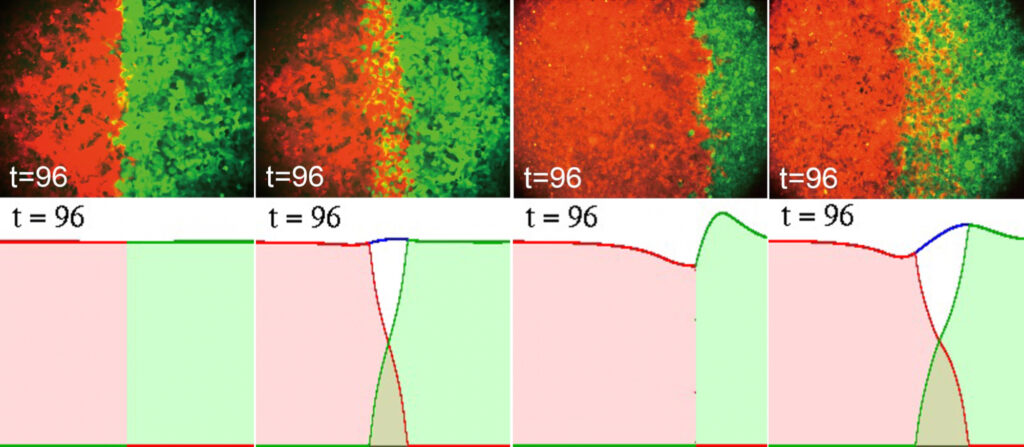
Gissell Estrada-Rodríguez (DMAT, CRM) Mathematical modelling of biological, physical, and social phenomena using partial differential equations (PDEs) to describe the average behaviour of underlying microscopic (individual-level) dynamics has received significant attention [6, 11]. Since A. Turing’s foundational work on reaction–diffusion systems, followed by the influential chemotaxis model by Patlak, Keller, and Segel in the 1950s

Research Highlights

A rigorous derivation of the asymptotic wavenumber in spiral wave solutions of the complex Ginzburg-Landau equation by Inmaculada Baldomá Barraca

Inmaculada Baldomá Barraca (DMAT, CRM) In a wide range of physical, chemical, and biological systems modelling the interaction among different species, the dynamics of each species is usually governed by a diffusion mechanism together with a reaction term, which takes into account the interactions with the other species. For example, such systems arise when modelling

Research Highlights

Quantum error-correcting codes and their geometries, by Simeon Ball

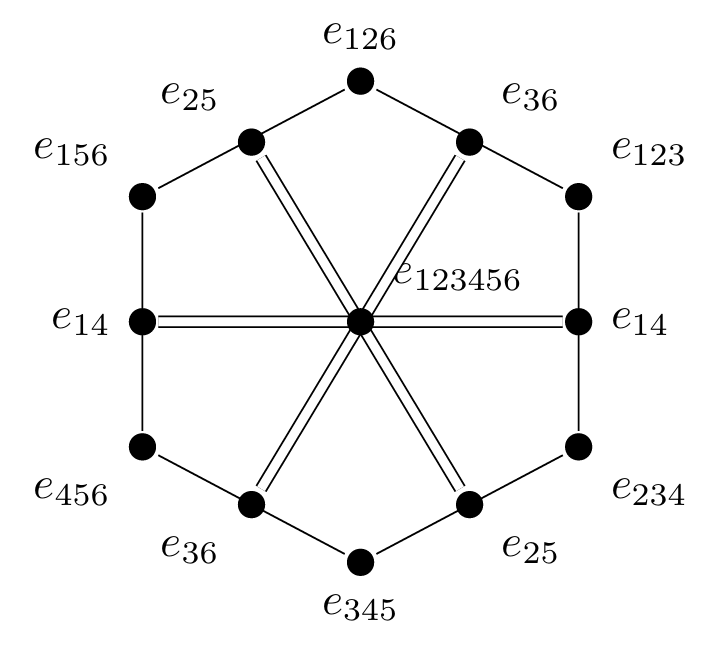
(DMAT, IMTech) A qubit is a two-state quantum-mechanical system. For example, the intrinsic angular momentum (spin) of an electron is such a system. It only takes two values when measured in arbitrary spatial direction, say by measuring the electrons deflection when passing by a magnetic field. The two corresponding spin-states are commonly referred to as

Scroll al inicio