
(DMAT, IMTech)
A qubit is a two-state quantum-mechanical system. For example, the intrinsic angular momentum (spin) of an electron is such a system. It only takes two values when measured in arbitrary spatial direction, say by measuring the electrons deflection when passing by a magnetic field. The two corresponding spin-states are commonly referred to as «spin up» and «spin down» states with respect to that direction. In mathematical terms a qubit is represented by a unit vector in 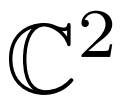 . The spin up and spin down (or any other choice of a pair of physically distinguishable states) are represented by an orthonormal basis |0⟩ and |1⟩. A typical qubit reads
 Let
Let  be the complex conjugate of the complex number
  . When measured, the qubit is found in state |0⟩ («spin-up») with probability
 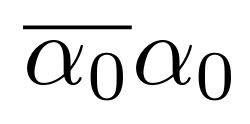 and is found in state |1⟩ («spin down») with probability
 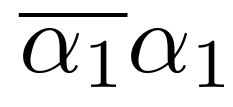 .
.
The «ket» notation 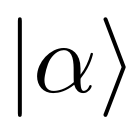 is used for a column vector, whilst the «bra» notation
 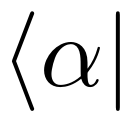 is used for a row vector whose coordinates are the complex conjugates of the coordinates of . The inner product or «bra-ket» on is defined as
 The Pauli matrices,
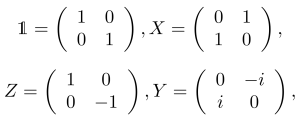 are unitary linear transformations of which form a basis for the space of 2 x 2 matrices.
A system of n qubits is described in the n-fold tensor product space of the one-qubit spaces, the 2n-dimensional Hilbert space  (n times).
The time evolution of n qubits is given by unitary operators on 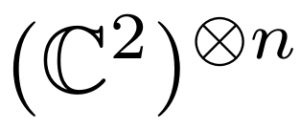 ,
,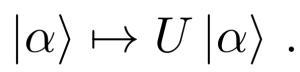 The aim of quantum error-correction is to encode k qubits of information on n qubits in such a way that an error, given by a unitary operator, can be corrected and the correct information restored to the qubits.
The Pauli group 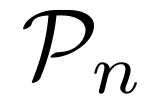 of unitary operators is generated by all possible tensor products of the 4 Pauli matrices, together with phases ±1 or ±i. It is a non-abelian group whose elements either commute or anti-commute (ab=-ba). In general, any error can be written as a linear combination of the Pauli operators. Moreover, any linear combination of correctable errors is correctable [8, Theorem 10.2].
A quantum error-correcting code is a 2k-dimensional subspace 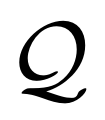 of into which k logical qubits can be encoded such that all errors of a certain type can be corrected. The following theorem from [7], and also [4], details exactly the set of errors that can be corrected by .
Theorem 1. A set of errors 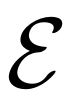 can be corrected by if and only if for all
 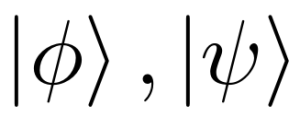 in and errors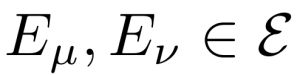
 for some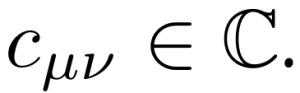
This condition implies the essential property: orthogonal states in remain orthogonal under the action of errors. weight 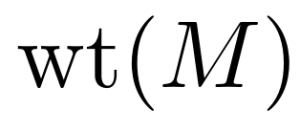 of an operator M in the Pauli group is the number of tensor factors which are not equal to the identity matrix. If contains all Pauli operators of weight at most t, then the quantum code is a t-error correcting code.
A qubit stabilizer code 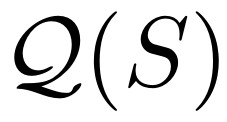 is the joint eigenspace with eigenvalue 1 of the elements of an abelian subgroup S of , i.e.
Let Centraliser(S) denote the set of elements of that commute with all elements of S, i.e. the centraliser of S in the group . Theorem 1 implies the following theorem [6].
Theorem 2. can correct all errors in 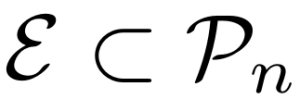 unless there are such that
 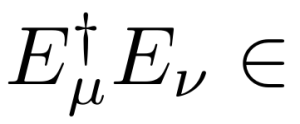 Centraliser(S) \ S.
We say is a 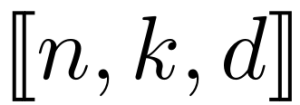 stabilizer code if is a 2k-dimensional subspace of and the Centraliser(S) \ S contains no Pauli operators of weight less than d.
Let 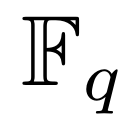 denote the finite field with q elements. The projective space PG(k – 1, q) is obtained from the vector space
 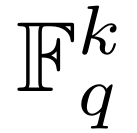 by identifying the vectors which are scalar multiples of each other.
Given a subgroup S, generated by n-k commuting elements M1, …, Mn-k of , we obtain a set 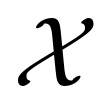 of n lines or possibly points in PG(n – k – 1, 2) in the following way. We construct a (n-k) x 2n matrix G(S) over
 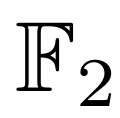 , whose j-th is row is obtained from Mj =
  , where the (i, i + n) coordinates of the j-th row are given by
  , specifically (0,0) if =
  , (0,1) if = Z, (1,0) if = X and (1,1) if = Y,
For each i ∈ {1, …, n}, we get a line (or a point) of by taking the span of the i-th and (i+n)-th column of G(S).
We define a parameter d() as the minimum number of dependent points that can be found on distinct lines of ; not including the dependencies for which there is a hyperplane which both
a) contains all the lines of which do not contain the dependent points,
b) contains all the dependent points.
In the definition of Glynn et al [5], the condition b) does not appear.
The following theorem from [2], which refines the main theorem from [5], describes the geometry of a quantum stabiliser code.
Theorem 3. The following are equivalent.
1. A stabilizer code , where S is a subgroup generated by n – k independent commuting elements of and whose centraliser contains no element of weight one.
2. A set of n lines spanning PG(n – k – 1, 2) with the property that every co-dimension 2 subspace is skew to an even number of the number of lines of and for which d() = d.
In the following example eJ denotes the vector in 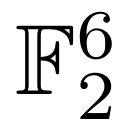 whose j-th coordinate is 1 if and only if j ∈ J.
The 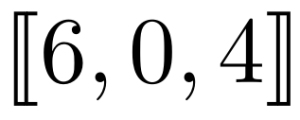 code is the sum modulo 2 of 16 planar pencils of lines, see Figure [1]. The cyclic structure allows one to check quickly that there are no three collinear points intersecting distinct lines of the six lines of the quantum set of lines. Indeed, the points of weight two obtained by summing two points incident with the quantum lines are cyclic shifts of 26, 36, 46 and the points of weight three obtained by summing two points incident with the quantum lines are cyclic shifts of 134 and 146. Therefore, the minimum distance of the code is at least 4. The points e126, e34, e16, e234 are four dependent points, implying that the minimum distance of the code is 4.
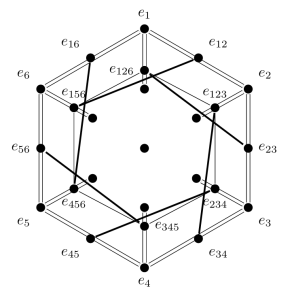
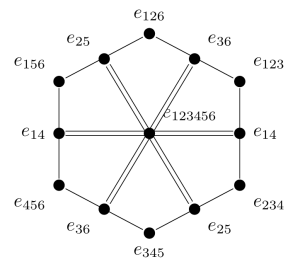
Figure 1: The quantum set of lines (the thicker lines) giving a code.
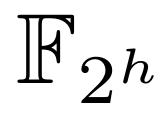
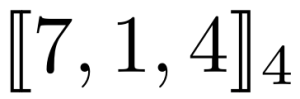
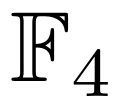
The geometrical approach to stabiliser codes was used successfully to resolve the long-standing existence question of whether there exists a 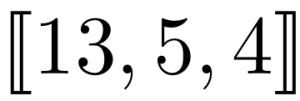 stabiliser code [3]. The question posed in [2, Research Problem 4] relating to the geometrical object which describes quantum stabiliser codes over non-binary fields has been resolved for fields of even chrarcteristic [1]. Defining a quantum set of n symplectic polar spaces of rank h in PG(r – 1, 2) as a set of n projective (2h – 1)-spaces spanning PG(r – 1, 2) each equipped with a symplectic polarity with the following property: every co-dimension two subspace intersects an even number of the elements of in a subspace π for which π⊥ is totally isotropic. This geometric object is equivalent to a quantum stabiliser code over
  and resolves [2, Research Problem 4]. Moreover, it was used successfully in the same article [1] to prove the non-existence of the
  and
and 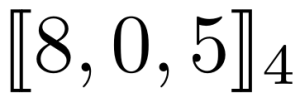 stabiliser codes over
  , another long-standing existence question. We still do not know of any geometric object which gives a useful description of stabiliser codes over fields of odd characteristic.
References
[1] S. Ball, E. Moreno and R. Simoens, Stabiliser codes over fields of even order, arXiv:2401.06618.
[2] S. Ball, A. Centelles and F. Huber, Quantum error-correcting codes and their geometries, Ann. Inst. Henri Poincare D, 10 (2023) 337–405.
[3] J. Bierbrauer, R. Fears, S. Marcugini and F. Pambianco, The nonexistence of a quantum stabilizer Code, IEEE Transactions on Information Theory, 57 (2011) 4788–4793.
[4] C. H. Bennett, D. P. DiVincenzo, J. A. Smolin, and W. K. Wootters, Mixed state entanglement and quantum error correction, Phys. Rev. A, 54 (1996) 3824.
[5] D. G. Glynn, T. A. Gulliver, J. G. Maks and M. K. Gupta,
The Geometry of Additive Quantum Codes, unpublished manuscript. (available online at https://www.academia.edu/17980449/)
[6] D. Gottesman, Stabilizer Codes and Quantum Error Correction, PhD Thesis (1997) (available online at https://arxiv.org/abs/quant-ph/9705052).
[7] E. Knill and R. Laflamme, A theory of quantum error-correcting codes, Phys. Rev. A, 55 (1997) 900.
[8] M. Nielsen and I. Chuang, Quantum Computation and Quantum Information, Cambridge University Press, 2000.