Latest Posts

PHD Thesis

Data assimilation for real-time dynamic prediction of wind-induced forces in vehicle platooning by Rafel Perelló i Ribas

Rafel Perelló i Ribas submitted his PhD thesis Data assimilation for real-time dynamic prediction of wind-induced forces in vehicle platooning, supervised by Antonio Huerta and Sergio Zlotnik at the Universitat Politècnica de Catalunya (November 2025). Nowadays, in the field of automotive aerodynamics, there is a big concern on concepts such as safety and energy efficiency.
PHD Thesis

Oscillatory motions, parabolic orbits and collision orbits in the planar circular restricted three-body problem by José Lamas Rodríguez

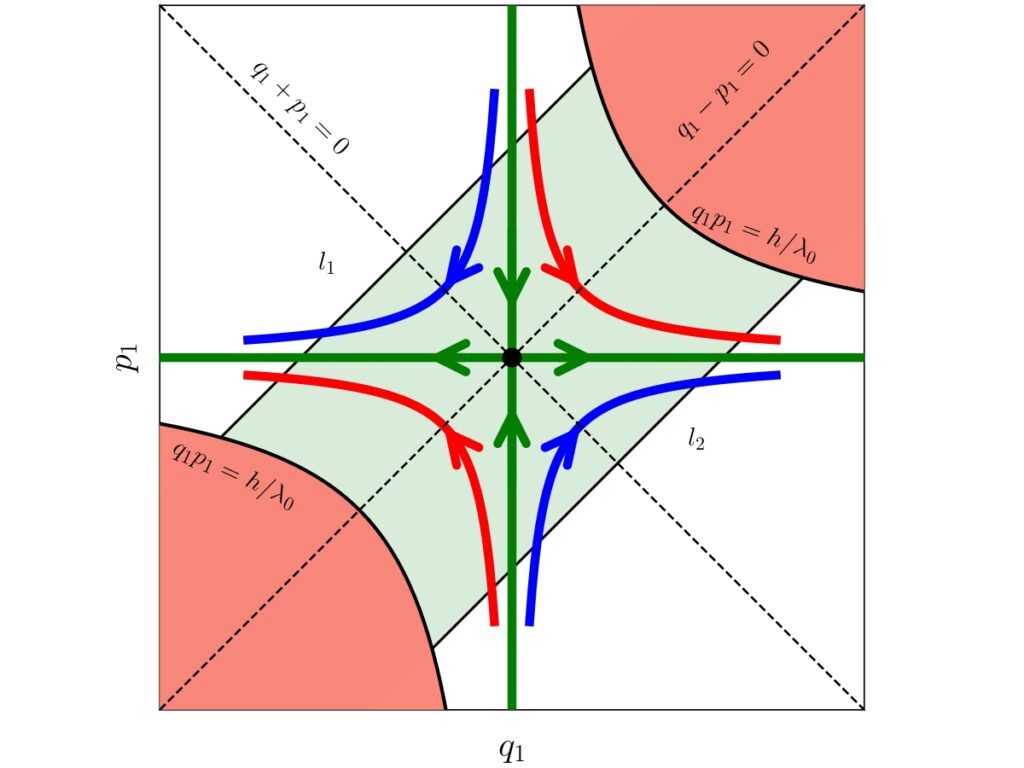
José Lamas Rodríguez submitted his PhD thesis Oscillatory motions, parabolic orbits and collision orbits in the planar circular restricted three-body problem, supervised by Marcel Guàrdia Munárriz and Tere M-Seara Alonso at the Universitat Politècnica de Catalunya (April 2025). Celestial mechanics is a classical meeting point between physics and mathematics. Its starting point is deceptively simple:

Research Highlights

Geometry and physics with geometric algebra, Geometric Mechanics, Vol. 2, No. 3 (2025), 337–383. by Sebastià Xambó

Geometric Mechanics, Vol. 2, No. 3 (2025), 337–383. Sebastià Xambó (DMAT) This work is dedicated to the memory of Miguel Carlos Muñoz Lecanda (MCML) (1946-2023), who was a Full Professor at UPC. Broadly speaking, his scientific interests were focused on the interactions between mathematics (mainly differential geometry) and physics (geometric mechanics, classical field theory), but

Research Highlights

Collective migration across scales: From PDEs to physical swarms by Gissell Estrada-Rodríguez

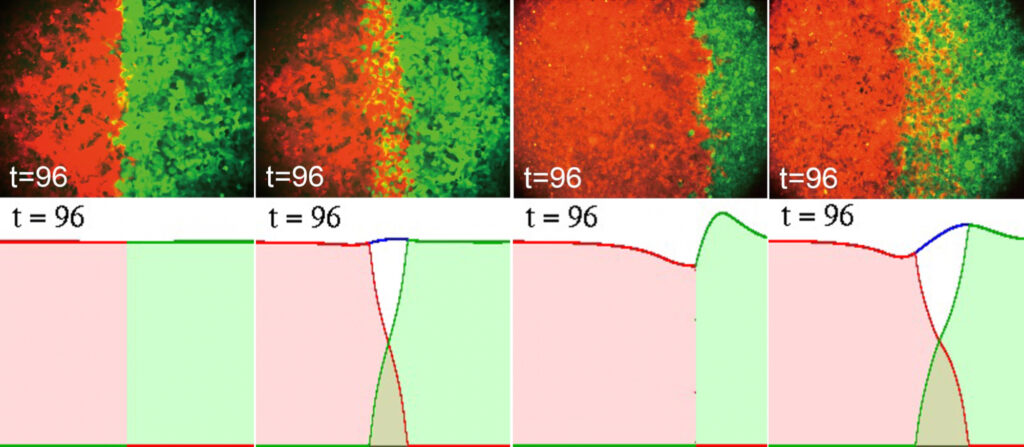
Gissell Estrada-Rodríguez (DMAT, CRM) Mathematical modelling of biological, physical, and social phenomena using partial differential equations (PDEs) to describe the average behaviour of underlying microscopic (individual-level) dynamics has received significant attention [6, 11]. Since A. Turing’s foundational work on reaction–diffusion systems, followed by the influential chemotaxis model by Patlak, Keller, and Segel in the 1950s

Scroll al inicio