
David Codony (LaCàN Group, IMTech)

The flexoelectric effect. In the world of smart materials, electromechanical transduction —the ability to convert mechanical force into electricity and vice versa— is ubiquitous, and represents the backbone of modern devices: from consumer electronics (smartphone haptics, inkjet printers, voice recognition devices) to medical devices (ultrasound imaging, precision surgery) and automotive industry (fuel injectors, parking sensors), to name a few. Most of these devices rely on piezoelectric transduction —physical coupling between uniform deformation and electric field— which is restricted to specific, non-centrosymmetric crystals only. Our research group is exploring an alternative, yet elusive electromechanical transduction mechanism: flexoelectricity, which is a universal property of all dielectric materials.
Flexoelectricity refers to the two-way coupling between strain gradients (non-homogeneous deformations like bending) and electric fields: bend it, and it kicks out voltage; zap it, and it bends (20).

Mathematically, it is governed by a coupled system of fourth-order partial differential equations written in terms of mechanical displacements \(\boldsymbol{u}\) and electric potential \(\phi\) —or more precisely, the strains \(\boldsymbol{\varepsilon}=sym(\nabla\boldsymbol{u})\) and electric fields \(\boldsymbol{E}=-\nabla\phi\)— as
\begin{align*}
\nabla\cdot\boldsymbol{\sigma}+\boldsymbol{b} &= \boldsymbol{0},\quad\text{(Mechanical balance of momentum)}
\\
\nabla\cdot\boldsymbol{D} – q &= 0,\quad\text{(Gauss’s law for electrostatics)}
\end{align*}
with the constitutive equations \(\boldsymbol{\sigma}(~\boldsymbol{\varepsilon},~\nabla(\nabla\boldsymbol{\varepsilon}), ~\boldsymbol{E}, ~\nabla\boldsymbol{E}~)\) and \(\boldsymbol{D}(~\boldsymbol{E},~\nabla(\nabla\boldsymbol{E}),~\boldsymbol{\varepsilon},~\nabla\boldsymbol{\varepsilon}~)\), both depending on low- and high-order mechanical and electrical kinematic variables.
Since the flexoelectric effect is governed by the change in deformation over a distance, it only becomes powerful enough at micro- and nano scales, where strain gradients are inherently large. At such small scales (\(\ell\)), bulk effects —including flexoelectricity— compete with other surface effects, which become more and more dominant at smaller scales, simply because area (\(\ell^2\)) reduces at a slower rate than volume (\(\ell^3\)) upon device miniaturization (\(\ell\rightarrow0\)).
Recent Results: The Emergent “Piezoelectric Skin”. Our recent work has shifted the focus from the bulk of the material to its surfaces. We have noticed that in purely flexoelectric samples, the simple presence of a free surface breaks the material’s symmetry [3], causing boundary layers to naturally emerge in the strain and electric field profiles, even if bulk effects only are accounted for (21). The behavior of the material “skin” resembles that obtained with models that explicitly include surface piezoelectricity and other surface effects.
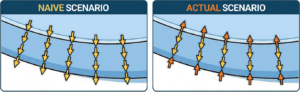
Upon analytical [2, 3] and numerical [2] studies, we showed that these boundary layers grow exponentially near the surface, with specific characteristic lengths depending on mechanical, dielectric and flexoelectric material properties. Furthermore, we have demonstrated that in lattice metamaterials —–structures with very high surface-to-volume ratios— these surface effects can significantly enhance or even dominate the overall electromechanical macroscopic response.
Computational Challenges: Solving the “Sharp + Smooth” Physics. The numerical modeling of these effects presents significant computational hurdles. One the one hand, traditional numerical methods, like standard finite elements, struggle with flexoelectricity equations because high-order continuity across elements is required. Typically, smooth alternatives are considered, including B-spline-based approaches [1] or finite element formulations enforcing weak \(C^1\) continuity across elements [4], among others.
On the other hand, smooth approximants struggle when it comes to capturing sharp boundary layers, often requiring specialized mesh refinement near boundaries. The presence of sharp layers may also require addressing the numerical instabilities of the computations.
Upcoming Research: Surface-aware Analytical Modeling. Despite the demonstrated relevance of surface effects in flexoelectric materials at high surface-to-volume scenarios, they are frequently overlooked, particularly in analytical modeling. This is the case of one-dimensional models, like Euler-Bernoulli flexoelectric beam theories. These theories typically assume constant strain gradients and electric fields along the cross section, thereby ignoring their naturally-emerging transversal boundary layers.
To address these challenges, we are working on a high-order formulation for flexoelectric beams that intrinsically accounts for boundary layers. This formulation, validated against numerical computations, enables in turn an accurate characterization of the non-vanishing longitudinal electric fields —also typically neglected—, which are crucial for the electromechanical operation of architected flexoelectric devices based on truss structures.
References
[1] David Codony, Onofre Marco, Sonia Fernández-Méndez, and Irene Arias. An immersed boundary hierarchical b-spline method for flexoelectricity. Computer Methods in Applied Mechanics and Engineering, 354:750–782, 2019.
[2] Mònica Dingle, Irene Arias, and David Codony. Continuum and computational modeling of surface effects in flexoelectric materials. Computer Methods in Applied Mechanics and Engineering, 441:117971, 2025.
[3] Hossein Mohammadi, Francesco Greco, David Codony, and Irene Arias. Flexoelectricity causes surface piezoelectric-like effects in dielectrics. International Journal of Mechanical Sciences, 293:110162, 2025.
[4] Jordi Ventura, David Codony, and Sonia Fernández-Méndez. A \(C^0\) interior penalty finite element method for flexoelectricity. Journal of Scientific Computing, 88(3):88, 2021.