Latest Posts

PHD Thesis

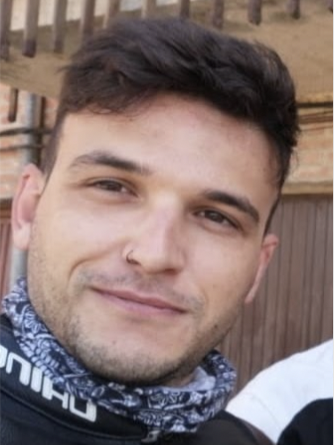
Robotic manipulation of cloth: mechanical modeling and perception by Franco Coltraro

Franco Coltraro defended his PhD thesis Robotic manipulation of cloth: mechanical modeling and perception, supervised by Professors Jaume Amorós and Maria Alberich-Carramiñana, on March 30th, 2023 within the UPC doctoral program in Applied Mathematics. Currently, he is a postdoctoral researcher at the Institut de Robòtica i Informàtica Industrial (IRI), CSIC-UPC in Barcelona. Thesis summary We […]

PHD Thesis

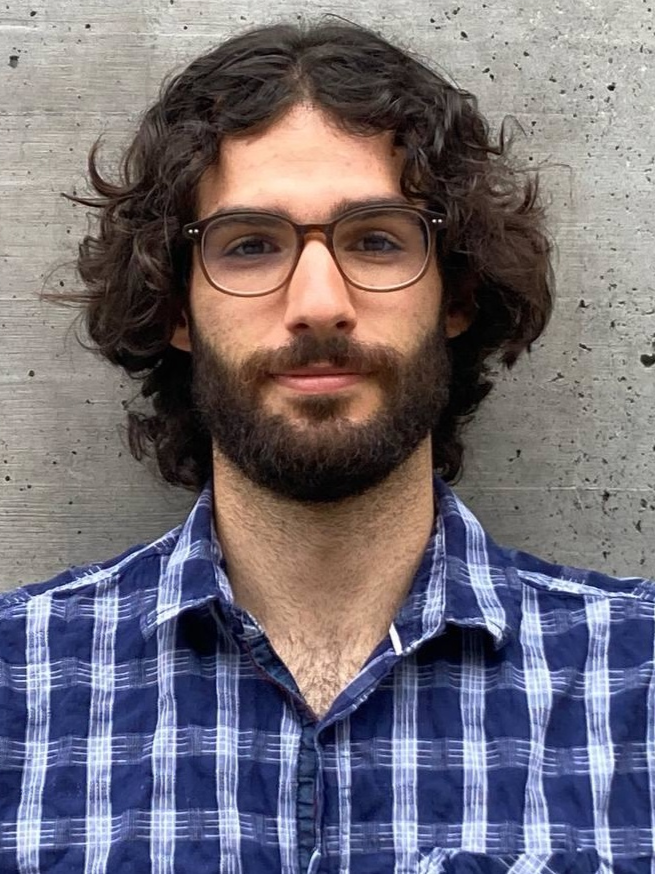
First Order Logic of Random Sparse Structures by Alberto Larrauri

Alberto Larrauri defended his PhD thesis First Order Logic of Random Sparse Structures on March 03, 2023. The thesis was produced within the UPC doctoral program on Applied Mathematics and his advisor was Marc Noy. Starting May 2023, he will be a postdoctoral researcher at the University of Oxford in the group of Standa Živný.

PHD Thesis

A theoretical and computational study of the active self-organization of nematic patterns in thin cytoskeletal layers and their effect on curvature by Waleed Mirza

Waleed Mirza defended his PhD thesis A theoretical and computational study of the active self-organization of nematic patterns in thin cytoskeletal layers and their effect on curvature, supervised by Marino Arroyo on 16 February 2023 within the UPC doctoral program in Applied Mathematics. Currently he is in the group of Alejandro Torres-Sánchez at the European

Colloquium

Marta Mazzocco

Professor Marta Mazzocco (University of Birmingham) will speak at the IMTECH Colloquium on Wednesday February 8 at 15h30 at Sala d’actes de la Facultat de Matemàtiques i Estadística (FME). Professor Mazzocco is Professor of Mathematics at University of Birmingham (UoB). She holds a PhD in Mathematical Physics from the International School of Advanced Studies (SISSA,

Research Highlights

Quantum character varieties by Marta Mazzocco

(School of Mathematics, Birmingham). Received on 8/2/2023. In this note we will introduce the concept of character variety in the simple example of a torus with one disk removed. We will show how this is a surface in C^{3} defined by a cubic polynomial, called the Markov cubic. We will show the relation between the

Scroll al inicio