Sergi Pérez submitted his PhD thesis Finite Element computational modeling of flexoelectricity and flexo-photovoltaics, supervised by Sonia Fernández and Irene Arias at the Universitat Politècnica de Catalunya (July 2025). He is currently expanding his doctoral research as a postdoctoral researcher at Barcelona Supercomputing Center (BSC).
 The PhD focuses on the numerical modeling of flexoelectricity and flexo-photovoltaics, both at infinitesimal and finite deformations, using standard \(\mathcal{C}^0\) Finite Element (FE) approximations.
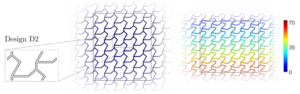
On one side, an alternative formulation to the drift-diffusion semiconductor modeling equations, relying on adimensionalized logarithmic quantities, is developed. The FE implementation of both formulations in an in-house MATLAB code is able to reproduce benchmark problems, demonstrating the benefit of the logarithmic formulation in convection-dominated scenarios, where coarser meshes are able to provide solutions without spurious oscillations. Furthermore, two non-linear solvers are assessed and compared: a monolithic Newton-Raphson method and the Gummel method. On the other side, the focus is placed on the development of the extension of \(\mathcal{C}^0\) Interior Penalty formulations for the solution of the partial differential equations (PDE) modeling linear flexoelectricity, including additional converse flexoelectricity and gradient dielectricity effects, and on the development of a combined \(\mathcal{C}^0\) Interior Penalty Newton-Raphson method for the solution of the non-linear PDE modeling flexoelectricity at finite strains. The proposed schemes are able to avoid the drawbacks of \(\mathcal{C}^1\) approximation spaces or mixed formulations, enabling the solution of fourth-order PDE by standard FE approximations. The computational implementation of the developed numerical schemes has shown the expected high-order convergence of the methods, and is able to reproduce benchmark problems. Moreover, the developed frameworks are extended, incorporating generalized periodicity boundary conditions, to reproduce apparent piezoelectric metamaterials at large deformations.
Finally, the coupling of flexoelectricity and semiconductor modeling is carried out. Proof of concept experiments, simulated with the FE solution of the proposed coupled continuum model at infinitesimal deformations, are reported, comparing the obtained results with standard photovoltaic simulations. In addition, the thesis provides a continuum modeling approach for the flexo-photovoltaic effect at finite deformations.